AI innovation for orchestrating tomorrow’s enterprise
Spring 2026 marks a major step forward in Bizagi’s AI journey. This release is all about AI innovation, expanding how intelligence is created, embedded, and governed across business orchestration. AI becomes easier to build, safer to scale, and more powerful in real enterprise scenarios.
With Spring 2026, Bizagi evolves from applying AI inside processes to innovating how AI is designed, orchestrated, and monitored. New capabilities empower teams to create AI driven solutions faster, give AI Agents and Workers more autonomy with clear governance, and provide deeper visibility into how AI performs across the organization.
The following list consists of features, improvements and fixes that are relevant in this update.
Bizagi Maker is designed to help define solution intent rather than technical implementation.
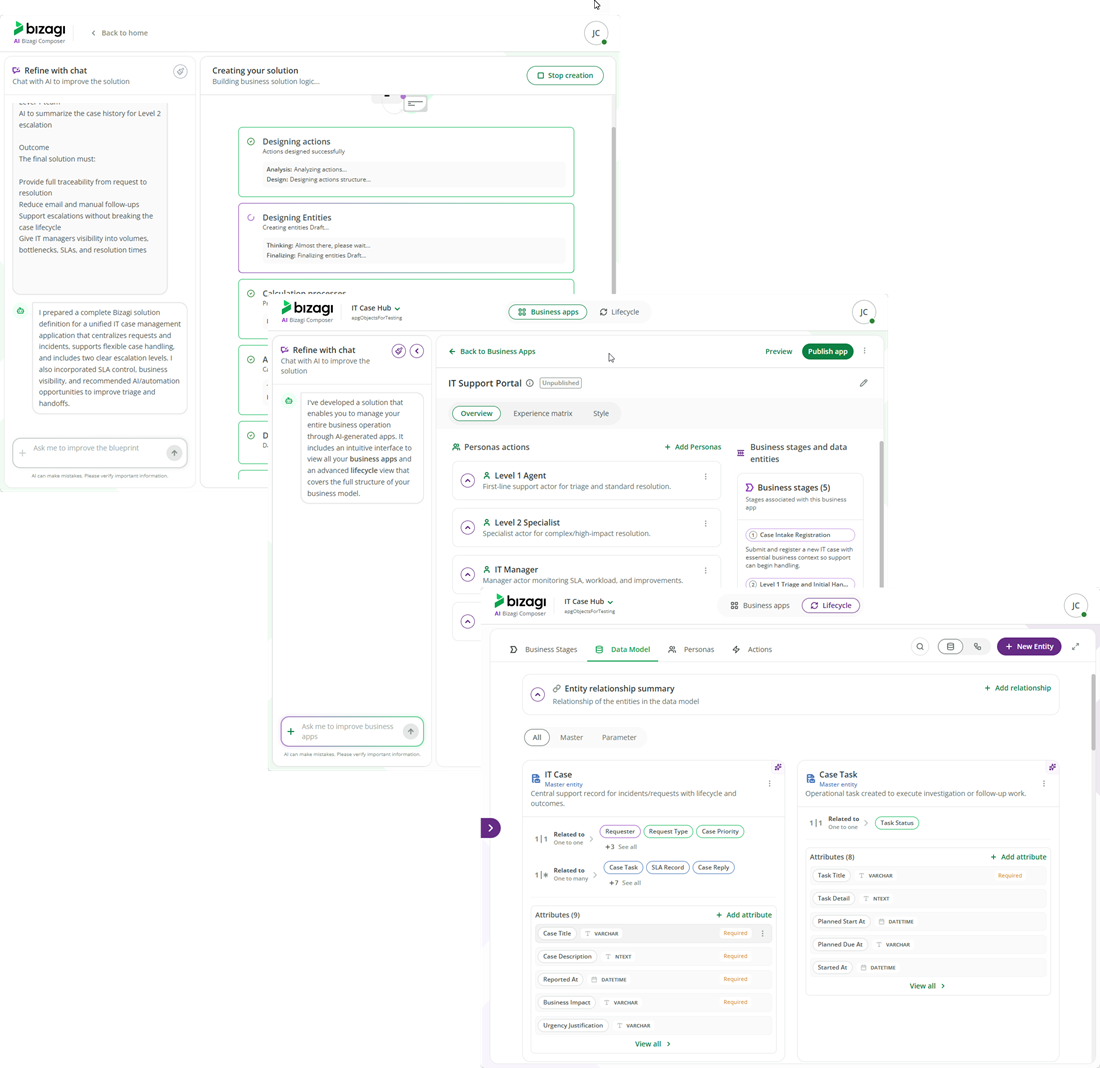
Start by describing the business problem to solve. This description can be high level and outcome focused, such as managing an end to end business scenario that includes structured steps, dynamic decisions, and human and AI participation.
From that description, Maker builds an orchestration plan. This plan is not yet an executable solution, but a structured overview of what the solution should include. It identifies the main roles involved, the types of experiences that are needed, and the key elements that will participate in the solution. This creates a shared understanding of the solution early on, before any technical details are finalized.
Maker is also designed to be iterative. As the solution intent is defined, users can review the generated structure and refine it.
Roles can be added or adjusted, responsibilities can be clarified, and missing elements can be identified. This interaction allows business and technical users to collaborate on the solution definition, guided by AI assistance but always in control of the final outcome.
Once the intent is clear and the orchestration plan reflects what the organization wants to achieve, Bizagi Maker moves from definition to generation.
Based on the approved plan, it creates all the elements needed for the solution to work, including data structures, relationships, stages, actions, and experiences. This removes much of the complexity traditionally involved in building enterprise solutions, while ensuring consistency and alignment with the original intent.
Maker also provides different perspectives on the generated solution to make it easier to understand and evolve.
One view focuses on personas and business objects, helping teams see who can do what across the solution.
Another view focuses on lifecycle and stages, showing how work progresses toward goals over time. These views help teams reason about behavior, responsibilities, and outcomes without diving immediately into low level implementation.
By separating intent from execution, Bizagi Composer becomes the starting point for universal orchestration. It ensures that solutions are designed around business objectives rather than rigid flows, and it creates a solid foundation for managing complex, evolving work. Once a solution is defined and published, it is ready to move into execution, which is where orchestration at runtime comes into play through the Bizagi Orchestration Manager.
Defining a solution is only the first part of the journey. Once a solution has been created with Bizagi Maker and published, it needs to run in the real world, where work is constantly changing and decisions must be made based on context, priorities, and available information. This is where runtime orchestration becomes essential.
At runtime, a solution is no longer just a design, it is a living system with active cases, people interacting with them, systems exchanging data, and AI participating in decisions. Traditional execution assumes that humans perform most actions and that the process engine controls the flow. Universal orchestration expands this model by allowing execution to be shared between humans and AI, in a controlled and transparent way.
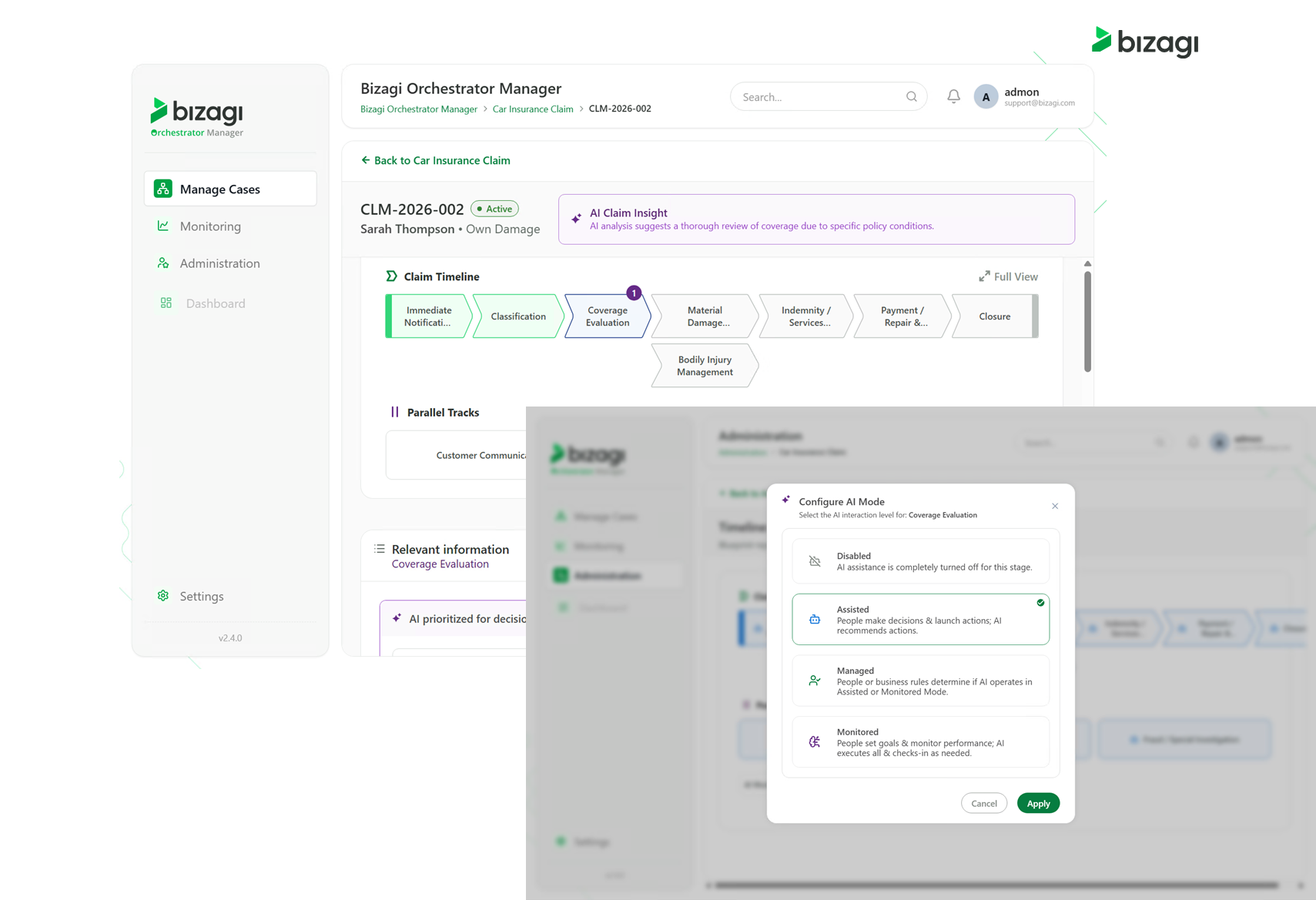
This execution layer is managed through the Bizagi Orchestration Manager. Its role is to control how the solution behaves while it is running. It allows organizations to decide, for each stage of a solution, how work should be orchestrated and who or what should be responsible for taking action.
Solutions executed through the Orchestration are organized around Stages, each with a clear goal.
A Stage defines what the solution is trying to achieve at that point, what conditions must be met to enter it, what actions are available while it is active, and what criteria indicate that the stage is complete. This structure allows work to progress even when the exact sequence of actions cannot be predefined.
Within each Stage, different types of actions can be executed. Some actions are performed by people, such as reviewing information or making a decision. Others are executed automatically by processes, rules, integrations, or AI components. The Orchestrator coordinates these actions, ensuring that they align with the stage goal and that outcomes are properly tracked.
A key aspect of runtime Orchestration is flexibility. The level of AI involvement is not fixed when the solution is designed. Instead, it can be adjusted as the solution runs. Organizations can choose to keep full human control over certain stages, allow AI to analyze situations and suggest actions in others, let AI execute actions when specific conditions are met, or fully delegate orchestration to AI while humans monitor outcomes. These choices can be changed over time, making it possible to adopt AI progressively and safely.
Transparency is also built into runtime orchestration. When AI executes or recommends actions, the reasoning behind those decisions is available for review. This ensures that automation remains explainable and auditable, which is critical in enterprise environments. Monitoring and governance capabilities provide visibility into how the solution is performing, how AI is being used, and whether outcomes align with expectations.
By separating solution intent from runtime execution, Bizagi enables a model where solutions can evolve without constant redesign. Composer defines what the solution is meant to achieve, while the Orchestration Manager governs how that solution is carried out in practice. Together, they make it possible to manage complex, real world scenarios where humans and AI collaborate to move work forward toward clear business goals.